At the time our troops were in Holstein, General Baur, who commanded the cavalry, and was himself a soldier of fortune, his family or country being a secret to every body, took an opportunity to discover himself, which surprised and pleased those who were about him.
Being encamped near Husun, in Holstein, he invited all his field-officers, and some others to dine with him, and sent his adjutant to bring a miller and his wife, who lived in the neighbourhood, to the entertainment. The poor couple came very much afraid of the Muscovite general, and were quite confused when they appeared before him, which he perceiving bade them make themselves quite easy, for he only meant to show them kindness, and had sent for them to dine with him that day, and talked with them familiarly about the country: the dinner being set, he placed the miller and his wife next to himself, one on each hand, at the head of the table, and paid great attention to them, inviting them to make free and eat hearty. In the course of the entertainment, he asked the miller a great many questions about his family and his relations: the miller told him, that he was the eldest son of his father, who had been also a miller at the same mill he then possessed; that he had two brothers, tradesmen; and one sister, married to a tradesman; that his own family consisted of one son and three daughters.
The general asked him, if he never had any other brother than those he had mentioned: he replied, he had once another, but he was dead many years ago, for they had never head of him since he enlisted and went away with soldiers when he was but very young, and he must certainly have been killed in the wars. The general observing the company much surprised at his behaviour to these people, thinking he did it by way of diversion, said to them; “Gentlemen, you have always been very curious to know who and whence I am; I now inform you, this is the place of my nativity, and you have now heard from this, my eldest brother, what my family is.”
And then turning towards the miller and his wife, he embraced them very affectionately, telling them he was their supposed dead brother; and, to confirm them, he relating everything that had happened in the family before he left it. … General Baur then made a generous provision for all his relations, and sent the miller's only son to Berlin for his education, who turned out an accomplished young man.
Friday, April 04, 2014
Long-lost relatives
Here's an interesting little story from the Memoirs of Peter Henry Bruce, Esq. (London, 1782). Bruce was a Scottish-born military engineer and artilleryman who served in the British, Prussian, and Russian armies, visiting places as far flung as Sweden and Iran.

Wednesday, March 26, 2014
The man who would be half-emperor
Another tale from Januarius MacGahan's Campaigning on the Oxus, and the Fall of Khiva.
One day I mounted my horse and rode to Hazar-Asp, where I was hospitably entertained by Colonel Ivanoff. While taking dinner with the Colonel, an orderly came in, and informed him that a woman was waiting outside, asking permission to lay a complaint before him
The Colonel turned to me and said, “come along now, and you will see something curious.”
As the regular course of justice had been interrupted by the flight of the Governor, the people of Hazar-Asp, it seemed, came to Colonel Ivanoff, who was then the supreme power, to have their wrongs redressed and their quarrels settled. So we now went out into the great porch, which I have spoken of as the Hall of State, or audience chamber. Here we sat down on a piece of carpet, and the Colonel put on a grave face, as befitted a magistrate in the administration of justice. The woman was now led into the court which was some three or four feet lower than the floor of the porch on which we were seated, she came in leading a lubberly-looking young man of about fourteen, and bowing almost to the earth at every step, and addressed the Colonel, whom she took for General Kauffmann, as the “Yarim-Padshah,” or ‘half-emperor’, which title the Colonel accepted with grave composure.
She was an old woman, clad in the long dirty looking tunic of the Khivans. The only article of dress that distinguished her from a man was the tall white turban worn by all the Khivan women. She brought in a little present of bread and apricots, which she handed to the bemused Colonel with many profound bows, and then proceeded to state her case.
“My son,” she said, pointing to the gawky boy who accompanied her, “had been robbed of his affianced wife.”
“By whom?” asks the Colonel.
“By a vile theiving dog of a Persian slave. My own slave, too; he stole my donkey, and carried the girl off on it; may the curse of the prophet wither him.”
“So then he is three times a thief. He stole the donkey, the girl, and himself,” said the Colonel, summing up the matter in a judicial way. “But how did he steal the girl? Did he take her by force?”
“Of course; was she not my son's wife? How could a girl run away from her affianced husband with a dog of an infidel slave, except by force?”
“Who is she? How did she become affianced to your son?”
“She is a Persian girl. I bought her from a Turcoman who had just brought her from Astrabad, and I paid fifty tillahs for her. The dog of a slave must have bewitched her, because as soon as she saw him she flew into his arms, weeping and crying, and said, ‘he was her old playmate’. That was nonsense, and I beat her for it soundly. The marriage was to be celebrated in a few days; but as soon as the Russians came, the vile hussy persuaded the slave to run away with her, and I believe they are as good as married”
“Well, what do you want me to do about it?”
“I want you to give back my son's wife, and my donkey, and my slave.”
The Colonel told her, with a smile, that he would see about it, and motioned her to retire from his presence. She withdrew, walking backwards, and bowing to the ground at every step, in the most approved and courtier-like manner. Evidently it was not the first time she had pleaded her own case.
But her son never got back his wife, nor she her slave or donkey.
Monday, March 17, 2014
Victorian War Correspondents
Januarius MacGahan (1844–78), a gentleman reporter of the old school, describes his journalistic equipment for a trip into Central Asia to cover the Russian invasion of Khiva in 1873.
"Being a man of peace, I went but lightly armed. A heavy double-barrelled English hunting rifle, a double-barrelled shotgun – both of which pieces were breech-loading – an eighteen-shooter Winchester repeating rifle, three heavy revolvers, and one ordinary muzzle loading shotgun – throwing slugs – besides a few knives and sabres, formed my light and unpretentious equipment. A hundred rounds for each of my guns and revolver were equally divided, with many other little traps, among the four saddle-horses.
Nothing was farther from my thoughts than fighting. I only encumbered myself with these things in order to be able to discuss with becoming dignity questions relating to rights of way and of property with the inhabitants of the desert, whose opinions on these subjects are somewhat peculiar."Campaigning on the Oxus, and the Fall of Khiva, p.146.
Monday, February 17, 2014
Fear and Loathing in Danzig
From an account by a French tourist, written in 1663.
We were on the point of leaving, when a man some six feet tall came in. He had a clean shaven face, and eyes set in deep folds and wrinkles. It was a Polish nobleman in the company of some fifteen retainers… As soon as he saw us, he came over with a declarations of friendship, shaking our hands and pressing us to accept his expression of respect and chivalry… He said he was ill, and that he had been looking for two weeks for someone who might confirm his belief that debauchery was a better cure than dieting… After we had consumed some fifteen or sixteen tumblers, my colleague offered him his pipe…. He thrust the bowl into his mouth, drawing the full draught of burning smoke straight into his stomach… He said that tobacco should be drunk not blown into the air and wasted… Suddenly, he rushed from the table and, seizing a lighted candelabra started to bang his head on the wall and writhe around on the floor. He was foaming at the mouth like a bull, and looked as if the fury would kill him… But then a little vomiting made him more presentable… Next he staggered blindly in my direction, smothered me with passionate kisses, and announced that he would give me one of his daughters in marriage, together with ten thousand pounds and two hundred serfs. In honour of the forthcoming marriage, we drank toast after toast… Then I looked around and saw that he was stretched out on his back once more, but calling for wine and urging us to drink to the confusion of the Turk and the ruin of the Ottoman Empire. .. By now he had assured me that I was really a Pole, and that I ought to dress like one. Starting with his crimson cloak, fastened with sculpted silver pins, he began to strip, and to dress me up from head to toe in his own clothes. Unbuckling his sabre, he ordered me to kiss it and fastened it to my side, declaring that Poland owed all her Freedom to it… Meanwhile, I was desperately planning my escape.Quoted in God's Playground: A History of Poland, vol 1. by Norman Davies.
Sunday, February 16, 2014
Shrewsbury Park, early 1990s
This story is from way back in the mists of time, when my hair was blond and my clothes brightly coloured. The memory has been swirled around like a piece of sea glass, smoothed and softened by the action of numerous forgettings. These days it's little more than the smell of leaf-mould and wet autumn woodland, a few still images, and a sense of something lost.
There was an area of half-forested parkland near the house where I grew up. I'm not sure whether it was laid out intentionally, or if it was just a patch of the hill that was too steep and unstable to build on. It had Victorian iron railings along the side near my house and half a rather grand gateway. By the time of my childhood the left-hand gatepost was long gone, along with most of the rest of the railing -- lost to vandals I suppose, or weather, or a wartime scrap-metal drive. Elsewhere, nature had quietly and patiently undone the carefully imposed Victorian order of the place. Tree roots snaked across stone paths and entwined themselves around long-extinguished gaslamps, tufts of grass levered apart paving slabs, and fallen leaves buried what remained. In the winter small streams ran down the hill and where they scoured away the earth you could see the layers than underpinned the crumbling pathways -- tarmac over concrete over bricks and logs and gravel.
The downhill side of the park was, curiously, home to feral cabbages and wild turnips, remnants of a wartime victory garden that had fallen into disuse. The uphill side comprised two open fields, where children played lopsided games of football against the steep slopes and the hilltop winds. Between these two areas was a small patch of woodland, probably less than an acre in size. This was my favourite part of the park growing up, a place where enormous puddles sucked the bright red wellingtons right off my feet and squirrels watched me from bizarre angles, crouched halfway up a tree trunk or on the underside of a branch.
I'm sure that every square inch of that little park was trodden by dozens of dog-walkers, bored teenagers and curious children every week, but to me it was somewhere exotic and unexplored. I can remember squeezing through gaps in the dense undergrowth to find odd little clearings and gullies, convinced that I was the first person to set foot there in decades, perhaps ever. The fact that I was never more than 10 metres from the footpath where my mother stood waiting didn't affect my enjoyment one bit. I remember one summer, coming across a sort of natural dome of holly under a great big willow tree deep in the bushes away from the paths. Inside there was a collection of plastic garden chairs around the remains of a small campfire, a sodden futon, and a load of empty beer cans. To me, it was like finding some kind of lost city deep in the jungle.
On the day that sticks in my memory, I was following one of the old fences that wound through the woodland, tracing the route of some long-forgotten footpath. For most of its length the fence was no more than a line of rotten wooden staves held together with baling wire -- I expect that if you were to go back there today there would be nothing left expect for a few strands of rusted metal half-buried in the earth. There was one point, however, where the fence was interrupted by a large metal gate, the kind people use to close off car-parks and private roads. I have no idea how long it had been there -- the path it spanned was barely wide enough for two people to walk down side-by-side -- but it was still in good condition. On either end of the gate was a box-steel post, hollow and open at the top.
As a approached this gate, I heard a faint squeaking noise, and then a tiny brown bird darted out and disappeared into the trees. Holding my breath and thinking in whispers, I tiptoed up to the post and looked down into it. At about the height that the mounting bolts for the gate went through the box-steel, there was a little birds nest, made from twigs and bits of carrier bags. The nest held three miniscule birds, just big mouths really, bundled together in a little ball.
I knew that disturbing a bird's nest was a naughty thing to do, so I darted back from the post and hid behind a tree. I waited for what felt like ages to my hyperactive and impatient little-boy-brain in the hope that the mother bird would come back to the nest, but she didn't show. I became worried that perhaps I'd scared her off and ran back to my mum.
I don't recall if I told her what I had seen or not, I probably did. I was really excited. Baby birds! Like on the wildlife shows! We tramped around the park for a little longer before heading home for lunch.
I didn't get to go back to the park for another week. When the weekend finally rolled around, I pestered my mum to take me out for a walk. I picked way way along the paths, looking for the rotting fence. It was late spring, and the plants were getting thicker and greener by the day, it took me quite a long time to find it.
Once again, I walked gingerly up to the gatepost, expecting to be dive-bombed by an angry mother-bird at any moment. She didn't seem to be around this time, and the nest was oddly quiet. I couldn't hear the twittering. I stood up on tiptoes and looked down into the post.
It took me a few seconds to realise what I was looking at. I glanced around, checking to make sure this was the right spot. It definitely was. Where the nest had been -- where the nest still was -- there was a brick. It was one of the mouldering, broken ones from the path nearby. Someone had shoved it into the hollow post, crushing the little nest and its tiny inhabitants.
I backed away slowly, making a sort of whimpering sound. Oddly, for a child prone to theatrical extremes of emotion, I didn't cry. This was, I figured, my fault somehow. It seemed inevitable, just like the way that the bigger boys at school were always breaking my lego castles or scribbling on my drawings. I'd gotten too excited, and the bigger boys had ruined everything.
Wednesday, February 12, 2014
Missing hours
I don't remember when exactly this happened. I was seventeen or eighteen, I think. Still at school, doing my a-levels, and living with my parents. I remember that it was a day much like this one -- a cold, sodden day on the dreary side of Christmas. One of my teachers was off sick, so I'd been home since about 2pm. The house was empty and silent aside from the odd knocking noise or crack or creak. I was sitting on the end of my bed, reading a book or doing some homework, I don't remember exactly. It was boring. I guess I fell asleep.
I had a strange, incoherent dream peppered with odd details that seemed to hint at some awareness of the world around me. Crows bellowed in my face and doorbells rang, my arm went numb. After some indeterminate amount of time, it all exploded with sharp, deafening noise. I don't know what the noise was, I later decided that it must have been the phone ringing, but with my mind mostly asleep it was just formless sound. Accompanied by this piercing klaxon soundtrack the dream became even stranger and more distorted. I started feeling panicky and trapped. I had the strange feeling that comes from screaming in a dream and, in some muffled and distant way, hearing your own voice echoing in your ears.
----
I was standing in the kitchen. My hair was disheveled and my clothes were all rumpled and askew. For a moment there was just complete blankness. My legs ached and my head hurt. I looked at the light from next door's patio and wondered why I was standing in the dark. I switched the lights on over the countertop and glanced up at the clock.
6:30.
I was up early today.
I pulled open the cupboard and took down the box of cereal. There wasn't any milk so I just sat at the kitchen table eating a dry, crusty brick of weatabix and gulping at a glass of water. It was odd that my parents weren't up yet. I couldn't even hear the faint drone of their clock radio.
Having decided that dry weatabix was, in fact, a terrible idea, I got up and looked around for my bag. I eventually found it in my bedroom, in the attic. My school books were scattered across my desk, my homework half done. I must have fallen asleep mid-way through. While I was gathering up my books and wondering why no-one had woken me up for dinner, I started to get the unsettling feeling that something wasn't right. My bedsheets were tangled and knotted, bunched into a ball at the foot of the bed. Try as I might, I couldn't actually remember getting up or getting dressed. In fact, come to think of it, wasn't I wearing these clothes yesterday?
I stood there for a while, trying to decide whether to change into a fresh shirt. ultimately my laziness triumphed over my admittedly feeble sense of propriety, and I walked back downstairs. On the first floor landing I stopped and poked the door to my parents' bedroom open with my foot.
The room was empty. For a moment I thought that perhaps they'd gotten up and gone downstairs while I was in my room, but I'd heard nothing and could hear nothing still. Sure enough it was just as empty downstairs as it had been before.
I was now very confused. I must have forgotten something. Perhaps dad had a meeting and mum had to go into work early? I couldn't remember anything being mentioned but, then again, I couldn't remember very much at all. Was I drunk?
I figured these mysteries could wait until later, and heaved my bag onto my shoulder. I popped in my headphones and opened the front door. It's English Literature this morning isn't it, Ms Long still pushing us through Dr Faustus.
---
I was fumbling with my keys, trying to lock the front door when my little sister tapped me on the shoulder. She was holding a bag of shopping. Mum was standing behind her. She asked where I was going this evening. I stared blankly at her for a good few seconds trying to figure out why she'd gone shopping at six o'clock in the morning before it clicked into place.
---
I still think of that day when I'm asked how long it's been since my last siezure. If I'm only counting the grand mal monsters -- the ones where my body jerks and flails like a broken robot or the hero of a really glitchy videogame -- then I've been seizure free since I was fourteen. I know, however, that there are other ways that the wires can cross.
Wednesday, January 29, 2014
Bug Chasing in Google Play Books
What I'm about to say concerns the epub rendering engine used by Google Play Books, the Californian tech-behemoth's first major attempt to break into the world of ebook retail. It will explain why I consider Google Play Books to be easily the weirdest e-reader available on the market today. As anyone who has worked with the standards-averse, held-together-with-gaffa-tape world of e-publishing will testify, competition for the title of "weirdest epub rendering engine" is always fierce, so this is quite a claim.
I think my findings back it up though.
---
Most e-readers ruin your books by not recognising certain CSS declarations, overriding them with their own defaults, or by implementing your CSS in a freakishly non-standard way – not so Google Play Books. The part of Google Play Books that handles CSS stylesheets – presumably forked from the Chrome browser – seems to be excellent, it can understand complex pseudo-class selectors and parse combinations of pseudo-class and pseudo-element selectors with ease. The problem comes from the way that it handles the HTML framework onto which that CSS is applied.
This first became apparent to me when I loaded one of the books I was working on into Google Play Books. This book had drop-caps on the opening body-text paragraphs of each chapter. These were identified using an HTML class (
When I loaded this book into Google Play books I noticed something odd. In addition to the drop cap on the first paragraph (which rendered very nicely), it added a drop cap to the first letter of the following page (the page break having fallen halfway through the first para). This seemed to imply that Google Play Books was altering my HTML in real-time (it reacted to changes in font-size and line-height that moved the page break), adding in a hard paragraph break on either side of the page break.
This was weird, but I just thought “meh, I've seen weirder” and changed the pseudo-class selector to counter this odd habit. The drop-cap selector now said
When I ran this code in Readium, it worked fine. When I ran it in Google Play Books, however, something really strange happened. The text sprouted drop caps everywhere – not only on the first paragraph of the chapter, but also on the first paragraph of each page and the first paragraph after each nested
Intrigued, I added another layer to my selector. I changed it to
This seems to imply that in order to render a book, Google Play Books takes the content from your epub and pastes it into an individual HTML document for each page. To make it even stranger, in order to work out where to put the page breaks it must have to apply the CSS to the HTML first, then work out where the page breaks will fall, then chop up the HTML into individual documents and re-apply the CSS. Only after it has gone through all that can it render the page.
This seems absurd, but it would explain some things about the odd behaviour of the Google Play Books app. For example, if you adjust the font size or line height, the screen goes blank and the whole thing has to reload before it can display the changes. This isn't something that any other e-reader does, but would make sense it it was having to re-generate a set of html files. Secondly, even simple books take a long time to load. The same book takes longer to load in Google Play Books – running on a brand-new android tablet – than it does on a first-generation iPad. Finally, there's the strange way that Google Play Books has to pause to load every six pages or so. There’s no way I know of to download and view a fragment of an HTML document, so logically there should only be a loading screen at the beginning of each chapter.
Unfortunately the only way to know exactly what it’s doing would be to break it open and rummage through the source code – a task I have absolutely no idea how to do (I'm just an editor who knows a bit of CSS).
I think my findings back it up though.
---
Most e-readers ruin your books by not recognising certain CSS declarations, overriding them with their own defaults, or by implementing your CSS in a freakishly non-standard way – not so Google Play Books. The part of Google Play Books that handles CSS stylesheets – presumably forked from the Chrome browser – seems to be excellent, it can understand complex pseudo-class selectors and parse combinations of pseudo-class and pseudo-element selectors with ease. The problem comes from the way that it handles the HTML framework onto which that CSS is applied.
This first became apparent to me when I loaded one of the books I was working on into Google Play Books. This book had drop-caps on the opening body-text paragraphs of each chapter. These were identified using an HTML class (
p.first) and a pseudo-element selector (::first-letter). I did it this way because it allowed swanky modern systems like iBooks and Readium to display drop-caps, but phrased it in such a way that Adobe Digital Editions and similar readers (which always render drop-caps wrong) would ignore it (pseudo elements mean nothing to them).When I loaded this book into Google Play books I noticed something odd. In addition to the drop cap on the first paragraph (which rendered very nicely), it added a drop cap to the first letter of the following page (the page break having fallen halfway through the first para). This seemed to imply that Google Play Books was altering my HTML in real-time (it reacted to changes in font-size and line-height that moved the page break), adding in a hard paragraph break on either side of the page break.
This was weird, but I just thought “meh, I've seen weirder” and changed the pseudo-class selector to counter this odd habit. The drop-cap selector now said
div.text>p:first-of-type::first-letter – selecting the first letter of the first child of the div.text container. I figured this would stop it from applying the drop cap to the second, artificial <p class="first">When I ran this code in Readium, it worked fine. When I ran it in Google Play Books, however, something really strange happened. The text sprouted drop caps everywhere – not only on the first paragraph of the chapter, but also on the first paragraph of each page and the first paragraph after each nested
<div>. This seemed to imply that Google Play Books was closing and re-opening the body text container at the end of each page and whenever the flow of text was interrupted by something.Intrigued, I added another layer to my selector. I changed it to
body>div.text>p:first-of-type::first-letter this absurdly convoluted selector should, in theory, have selected only the first letter of the first paragraph of the first div in the whole HTML document. What it actually did was select the first letter of each page. This seems to imply that in order to render a book, Google Play Books takes the content from your epub and pastes it into an individual HTML document for each page. To make it even stranger, in order to work out where to put the page breaks it must have to apply the CSS to the HTML first, then work out where the page breaks will fall, then chop up the HTML into individual documents and re-apply the CSS. Only after it has gone through all that can it render the page.
This seems absurd, but it would explain some things about the odd behaviour of the Google Play Books app. For example, if you adjust the font size or line height, the screen goes blank and the whole thing has to reload before it can display the changes. This isn't something that any other e-reader does, but would make sense it it was having to re-generate a set of html files. Secondly, even simple books take a long time to load. The same book takes longer to load in Google Play Books – running on a brand-new android tablet – than it does on a first-generation iPad. Finally, there's the strange way that Google Play Books has to pause to load every six pages or so. There’s no way I know of to download and view a fragment of an HTML document, so logically there should only be a loading screen at the beginning of each chapter.
Unfortunately the only way to know exactly what it’s doing would be to break it open and rummage through the source code – a task I have absolutely no idea how to do (I'm just an editor who knows a bit of CSS).
Monday, January 20, 2014
The Theaterbunker
On the corner of Islington Green, facing onto Essex Road, there is a rather swanky apartment block. It is about four stories high, with a central courtyard that faces onto Essex Road. The ground floor is finished with a sort of faux-marble effect -- less tacky than it sounds -- and the upper floors are clad with something like cedar weatherboarding. I wouldn't call it an attractive building, necessarily, but it's clear that more thought was put into its design than you'd expect for an apartment block, even somewhere as swanky as Islington.

I first encountered this building in the spring of 2008, when I started working in an office nearby. I used to walk past it on my way to the shops to get lunch, or when heading to the bookshop a few doors up the street. Though the building was mostly finished, there were still workmen on site handling the fitting out and big wooden hoardings covering the entrance to the courtyard on the Essex Road side. At the time I paid it no mind.
I started to think things were a bit odd when I noticed that, despite the construction hoardings and empty commercial units on the ground floor, people were living in the apartments on the upper floors. The windows had curtains and I'd sometimes see people wandering around inside. As the years passed a gym moved into the ground floor on the far end of the site, away from the green, and a penthouse apartment was added on to the top floor. The Islington Green end of the site, however, remained boarded up. The courtyard was hidden behind construction hoardings.

There were some other things about the building that struck me as odd. On the Essex Road side of the building there was a heavy-duty freight elevator that didn't seem to go anywhere (it's on the far right hand side of the picture above, notice that the room directly above it is someone's kitchen.) There are also several semi-concealed fire escape doors (the recesses on either side of the courtyard entrance) that don't appear to have staircases above them. All in all, it was a conundrum. I tried googling the building on several occasions, but came up with nothing. How do you google a building if you don't know the address or anything else about it?
Today, this changed. When I was walking past the building on my way to the shops, I saw a planning application note pinned to one of the hoardings. It was notice of an application for an entertainment licence (theatre/music venue) made on behalf of the 'Collins Theatre'.
I dashed back to my desk and started searching for information. At first I was frustrated by references to the Collins Music Hall, which stood on that site until it burned down in 1958, but I soon dug down to find the good stuff.
The first article I found was this one "Sally goes underground with £28m new theatre". It stated, to my astonishment, that there was a three-storey high basement under the site containing a 600 seat theatre. The article mentioned an architectural practice -- CZWG -- and a search for them turned up this page. At this point I dropped my soggy low-fat sandwich on my keyboard with a sguidgy flop of shock. Could it be that this basement, less than 100m from my office, was the final resting place of the reproduction of Shakespeare's Rose Theater, built for Shakespeare in Love?
My doubts as to whether this project had ever actually gone ahead were quashed by pictures I found on the websites of the firm that built the basement, and the firm that created the beautiful glass roof over the auditorium. More detail on the project was furnished by this 2008 article in The Stage, entitled "Mystery surrounds Islington’s Collins Theatre as opening beckons".
After 2008, however, it all seems to go quiet. The next mention I could find of the project was this article in the local paper "Waiting in wings... theatre still a shell after 20-year campaign", dated June 2009. Then, ominously, came this article in The Stage in September of that year, "BSC plans Shakespeare in Love’s Rose Theatre replica for northern base" linking the Rose Theatre reproduction with the BSC and suggesting that the Collins Theatre plan had fallen though. The next mention I could find of it was a passing mention in an article about a local Labour Party activist and artist called Avis Saltsman Baldry. According to "Great art grows on trees! Hugging Trees by Avis Saltsman at Islington Museum" she had been closely involved in the campaign to build the theatre. Her rather tetchy response, printed the following week, mentions that the state of the theatre was the "subject of litigation".
Nothing more seems to have been said on the subject until the summer of 2013. The letters page of the Islington Tribune from August contains the following letter "Still waiting for ‘curtain up’ at our underground theatre", written by Avis Saltsman Baldry. In this letter Ms Saltsman blames the Lib Dems and the economic downturn for the lack of progress on the project before complaining about the negative attitude of unnamed contractors in a manner that I can't really follow. Reading between the lines, it seems to imply that the theatre has no practical way to get large objects in and out, which seems rather a serious shortcoming.
I would be interested to know more about this history of this project, and how it came to collapse so spectacularly, but I suspect it will be many years and many legal battles before we find anything out. Nonetheless, there are some clues. In a 2008 article questioning the logic of building a shiny new theater in an area that is already very well served with cultural venues, Simon Wroe of the Islington Tribune mentions that the developer was granted an exemption from the affordable housing requirement in return for promising to build the theatre. It seems unlikely that they would do something as expensive as excavate a three storey basement just to avoid putting any social housing in their development, but stranger things have happened. It would certainly explain why they're so profoundly unconcerned by its emptiness.
Having gotten this far, I've just realised that I can't find the Islington planning department reference for the new application, which might shed some light on what is currently going on. I'll have to write it down and check tomorrow.
I first encountered this building in the spring of 2008, when I started working in an office nearby. I used to walk past it on my way to the shops to get lunch, or when heading to the bookshop a few doors up the street. Though the building was mostly finished, there were still workmen on site handling the fitting out and big wooden hoardings covering the entrance to the courtyard on the Essex Road side. At the time I paid it no mind.
I started to think things were a bit odd when I noticed that, despite the construction hoardings and empty commercial units on the ground floor, people were living in the apartments on the upper floors. The windows had curtains and I'd sometimes see people wandering around inside. As the years passed a gym moved into the ground floor on the far end of the site, away from the green, and a penthouse apartment was added on to the top floor. The Islington Green end of the site, however, remained boarded up. The courtyard was hidden behind construction hoardings.
There were some other things about the building that struck me as odd. On the Essex Road side of the building there was a heavy-duty freight elevator that didn't seem to go anywhere (it's on the far right hand side of the picture above, notice that the room directly above it is someone's kitchen.) There are also several semi-concealed fire escape doors (the recesses on either side of the courtyard entrance) that don't appear to have staircases above them. All in all, it was a conundrum. I tried googling the building on several occasions, but came up with nothing. How do you google a building if you don't know the address or anything else about it?
Today, this changed. When I was walking past the building on my way to the shops, I saw a planning application note pinned to one of the hoardings. It was notice of an application for an entertainment licence (theatre/music venue) made on behalf of the 'Collins Theatre'.
I dashed back to my desk and started searching for information. At first I was frustrated by references to the Collins Music Hall, which stood on that site until it burned down in 1958, but I soon dug down to find the good stuff.
The first article I found was this one "Sally goes underground with £28m new theatre". It stated, to my astonishment, that there was a three-storey high basement under the site containing a 600 seat theatre. The article mentioned an architectural practice -- CZWG -- and a search for them turned up this page. At this point I dropped my soggy low-fat sandwich on my keyboard with a sguidgy flop of shock. Could it be that this basement, less than 100m from my office, was the final resting place of the reproduction of Shakespeare's Rose Theater, built for Shakespeare in Love?
My doubts as to whether this project had ever actually gone ahead were quashed by pictures I found on the websites of the firm that built the basement, and the firm that created the beautiful glass roof over the auditorium. More detail on the project was furnished by this 2008 article in The Stage, entitled "Mystery surrounds Islington’s Collins Theatre as opening beckons".
After 2008, however, it all seems to go quiet. The next mention I could find of the project was this article in the local paper "Waiting in wings... theatre still a shell after 20-year campaign", dated June 2009. Then, ominously, came this article in The Stage in September of that year, "BSC plans Shakespeare in Love’s Rose Theatre replica for northern base" linking the Rose Theatre reproduction with the BSC and suggesting that the Collins Theatre plan had fallen though. The next mention I could find of it was a passing mention in an article about a local Labour Party activist and artist called Avis Saltsman Baldry. According to "Great art grows on trees! Hugging Trees by Avis Saltsman at Islington Museum" she had been closely involved in the campaign to build the theatre. Her rather tetchy response, printed the following week, mentions that the state of the theatre was the "subject of litigation".
Nothing more seems to have been said on the subject until the summer of 2013. The letters page of the Islington Tribune from August contains the following letter "Still waiting for ‘curtain up’ at our underground theatre", written by Avis Saltsman Baldry. In this letter Ms Saltsman blames the Lib Dems and the economic downturn for the lack of progress on the project before complaining about the negative attitude of unnamed contractors in a manner that I can't really follow. Reading between the lines, it seems to imply that the theatre has no practical way to get large objects in and out, which seems rather a serious shortcoming.
I would be interested to know more about this history of this project, and how it came to collapse so spectacularly, but I suspect it will be many years and many legal battles before we find anything out. Nonetheless, there are some clues. In a 2008 article questioning the logic of building a shiny new theater in an area that is already very well served with cultural venues, Simon Wroe of the Islington Tribune mentions that the developer was granted an exemption from the affordable housing requirement in return for promising to build the theatre. It seems unlikely that they would do something as expensive as excavate a three storey basement just to avoid putting any social housing in their development, but stranger things have happened. It would certainly explain why they're so profoundly unconcerned by its emptiness.
Having gotten this far, I've just realised that I can't find the Islington planning department reference for the new application, which might shed some light on what is currently going on. I'll have to write it down and check tomorrow.
Tuesday, May 14, 2013
ASMR
One of the blogs I regularly read is Vaughn Bell's excellent Mind Hacks, a blog about psychology, neuroscience and brain-things. Today there was a post about an unusual phenomenon known as ASMR (Auto Sensory Meridian Response)*. As I read the first paragraph it dawned on me, with some shock, that it was talking about something that I experience on a fairly regular basis (though not as regularly as I'd like). ASMR is the name given to a wonderful tingling sensation that sort of spreads out across your scalp like a wave, rippling out from the crown of your head and then zipping down your spine. It gives you goosepimples and makes all the hair on your body stand on end.
From reading this article and listening to this NPR piece. I've learned that this sensation is triggered by all sorts of different things in different people. For me it's watching, or listening, to someone concentrating intently and quietly on something. Someone methodically sorting things or looking for something small and hard to spot. It can also be triggered by listening to someone carefully explaining how something works, or guiding you through how to do a complex task.
I've had this feeling for as long as I can remember. When I was a little kid I used to conspicuously and deliberately sit near my mum and scratch my head like an itchy dog (though with my hands, obviously, I can't get my feet that high) in the hope that she'd notice and think I had nits (headlice). Having my hair checked for nits always set it off. I can also remember sitting on the carpet in primary (elementary) school, watching, transfixed, as Ms Robertson, my Year 4 (3rd grade) teacher, went through the register for the term, checking the attendance record of her whole class.
It has always been something fairly fleeting for me, it's rare for anyone to keep doing something that triggers it for very long, or at least, not without it being weird or inappropriate for me to sit and stare. The longest time I can remember being in this state was when I was eight or nine, sitting in the doorway between the kitchen and the back room of my childhood home, watching my uncle (a carpenter) carefully and methodically measuring our strangely-shaped kitchen for a set of new cupboards.
Unlike the woman in the NPR piece, I rarely seek this feeling out -- if nothing else, I don't think I get it as strongly as some people. That said, during a particularly stressful period of my third year of university I used to load up videos of guitar company reps explaining how complex effects pedals or amplifiers worked, for the sole purpose of triggering this feeling. Those lost their efficacy after a while and I didn't think to seek any others out (I came across those by accident when shopping online for a new compressor/sustainer pedal). As with some of the other people mentioned in the NPR piece, my ASMR (it's a silly name, but it's better than inarticulate nothing, which is what I had before) is occasionally inconvenient**, but never unwanted.
As part of the NPR piece the woman mentions that there's a whole subculture that caters to this feeling, and there's a shitload of ASMR porn (for want of a better word) on youtube. I just clicked nervously on one of these videos and found that yes, they do work for me, so I'm now going to switch off my head until Kristen gets home from work.
*The name doesn't really mean anything, it's just a vaguely sciencey-sounding acronym used by people on the internet.
**A few months back I was looking for a guide to opening the casing on my laptop (it was shorting and giving me shocks) and lost about an hour in a glazed over state watching videos of people explaining how to pop out the tabs around the battery casing.
Friday, May 10, 2013
At the moment I'm reading through a book called At Home and in War by Alexander Vasilyevich Verestchagin (long out of print, but available on the Internet Archive). It's an officer's memoir, detailing a career in the Russian military during the expansionist wars of the late nineteenth century. This isn't the sort of thing I read for fun, but it's a useful source on the otherwise little-known Battle of Geok Tepe, which I'm writing about for work.
Most books like these are rather grating and self-aggrandising, with the author determined to maximise his role in important events, and play down his own moments of weakness. This book, however, is very different. The first half is fairly unremarkable – just biographical details and descriptions of the life of an officer in a the peacetime army (having read plenty of Chekov and Puskin, this is not a world that is unfamiliar to me).
Once he gets into his actual experiences of war, however, it becomes much more vividly written. Take, for example, this passage, which describes his feeling as he rides up towards the frontline during the Siege of Plevna (1877) a particularly bloody engagement from the 1877–1878 Russo-Turkish War.
The most remarkable passage, however, comes a little later, when the preparations for the attack are in full swing. He rides forward and joins the other staff officers near the Generals’ observation post, who are nervously watching as their commanders argue over their plans.
Most books like these are rather grating and self-aggrandising, with the author determined to maximise his role in important events, and play down his own moments of weakness. This book, however, is very different. The first half is fairly unremarkable – just biographical details and descriptions of the life of an officer in a the peacetime army (having read plenty of Chekov and Puskin, this is not a world that is unfamiliar to me).
Once he gets into his actual experiences of war, however, it becomes much more vividly written. Take, for example, this passage, which describes his feeling as he rides up towards the frontline during the Siege of Plevna (1877) a particularly bloody engagement from the 1877–1878 Russo-Turkish War.
Look where you will, everywhere it is gray, and damp, and disagreeable; and you long to go somewhere and get warm. However, it is necessary to go on, and in precisely that direction, too, whence the thunder of the guns proceeds.
This thunder I begin to hear more and more clearly. Some of the discharges are wafted to me as distinctly as though there were by my side. A cannonade was in progress just now on the left, and immediately afterwards it had become inaudible. The troops are not yet in sight. I begin to get into a more and more nervous state; the question involuntarily occurs to me: “Shall I soon come within the line of fire?” This question disturbs me deeply because I have become convinced, from previous engagements, that being near the firing point and being directly under fire are two quite different things. I do not know how it may affect others, but it was very disagreeable for me on each occasion to take those last few steps. As long as there are no bullets, it matters not; everything is well and tranquil, although not wholly so, for you know that you will infallibly and speedily hear the ominous whistle. But now one has flown past – only one bullet – and already you are conscious of a change in yourself. Your heart begins to gnaw, as it were; a slight nausea manifests itself in your stomach; weakness and apathy diffuse themselves all over your body. It is a ridiculous thing to say, but I had already experienced the same sensation before the proposition of questions in my final Latin examination. On such occasions the same nausea appeared, the same weakness of the whole body, with cold perspiration on the forehead. The nervous state is produced, of course, by the consciousness that one may be wounded or even killed at any moment. All thoughts, all sensations are peculiarly concentrated and one involuntarily awaits the fatal bit of lead or iron, which will put an end to one’s existence.
The most remarkable passage, however, comes a little later, when the preparations for the attack are in full swing. He rides forward and joins the other staff officers near the Generals’ observation post, who are nervously watching as their commanders argue over their plans.
At that moment there impressed itself upon my sight the figure on one of our dead soldiers. Strong and vigorous, with long side-whiskers, and his face thrust into the miry road, he lay with his arms spread out, just beside the spot where the generals were walking. His cap had fallen off and laid bare his closely cropped, black head. It was strange to see how, as the chiefs walked, it never occurred to them to order the brave fellow to be taken away. They were thinking of other things than dead men.
A considerable time has elapsed. The cannonade increases in violence, the bullets whistle thicker and thicker. But Skobolev still paces to and fro with Prince Imeretinsky, and rubs his hands. The corpse still lies there, and seems to sink deeper in thought and to be wondering “Am I to say forever here in the rain?”
From the conversations of my comrades I learn that the general attack is ordered for three o'clock in the afternoon. It is only twelve o'clock now. At this moment, an officer steps up and reports to Skobolev: “Your Honor, the third brigade of sharpshooters has advanced.”
The General flies into a violent rage: “Who gave them orders? Don't they know that the general attack is only to come off at three o'clock? Well, let them die then, if they didn't know enough to wait!” Then he returns to his conversation with the Prince once more.
So about an hour later, Skobolev orders his horse to be brought round; we also make a dash for our horses, in order to follow the General. At that moment my brother Sergei rides up to me, in a short black jacket, on the small Turkish horse which I had given to him a couple of days previously.
“Seroga,” I shout to him, “Vasily Vasilitch asked me to tell you that you must give back his things, his wagon, and colours, for otherwise he cannot work at all!”
“This is no time to talk about such things, brother!” he answers, curtly, as he returns my greeting, then lashes his horse under the belly with his whip, and disappears at full speed in the direction of the lines.
I never saw him again.
Imeretinsky remains on the same spot, but we all follow Skobolev. Kuropatkin, who has been somewhere on the position, speedily follows us. Skobolev enters into conversation with him, without reducing the speed of his horse. This day was a memorable on to me; it is hardly likely that I shall ever forget it. We ride for half a verst directly ahead on the road. Shells burst incessantly over our heads. We reach the elongated, wooded ridge which has been visible to us from afar. Amid the vineyards at its base, our troops can be seen: here a company, there a battalion, and there again a whole regiment. Shrouded in the foliage they seemed few in numbers, though there were thousands of them here. They were all silently awaiting the word of command in order to advance – and whether they were fated to return from that spot, God only knew.
We pass through the troops, and, without ascending the ridge, we turn to the left and ride along its base. The very summit, covered with dark, branching trees and thick foliage, is almost completely enveloped in the smoke of gun-powder. Only a breeze blows it away here and therhe for a moment, which fresh clouds of smoke, even thicker and more impenetrable, again envelop and conceal the distant view. Here the fire is converted into a veritable hell. Heavens, what moments those were! The bullets whistled and groaned with piteous voices. Some, which must have proceeded from rifles, meow exactly like cats.
Compressing his lips a little, Skobolev rides along on his gray horse, with a gloomy facem now and then addressing a question to Kuropatkin. The latter, as though desirous of shielding his chief from the bullets, rides, contrary to custom, on the General’s right side; and I ride still further to the right that Kuropatkin. One ball strikes directly behind me. The thud is dull, and deeply disagreeable. “That surely must have hit someone,” I think to myself. I glance around – I am not mistaken: a Cossack on the Don, a brave fellow judging from his face, swarthy, and with a long black mustache, is sinking slowly, and without a moan, from his horse. With weak and trembling hand he has clutched to at the horse’s rein; grasping his lance with the other, he strives to hold himself upright in his saddle. But in vain! Heavens! how frightful was his face at that moment! – it rises before my eyes now, as I write. His mouth was distorted and half open, his eyes fixed and staring. Death had, suddenly, laid its grasp upon him. The bullet had struck him in the right side.
At such terrible moments, there is developed in each one of us, and to such a degree, the sentiment of self preservation, egotism, and self-love – each one of us so fears to present himself, even for a superfluous second, as a target for the bullets, that no one, even of the escort, of the comrades of the wounded man, halts in order to render assistance to the unfortunate fellow. All merely exchange significant looks, urge on their horses, and ride past the fatal spot as speedily as possible.
After the Cossack is killed, I mechanically rein in my horse and try to cross more to the left than Skobolev, calculating that, in such a position, the bullets, before reaching me, will have first to pierce Kuropatkin, then Skobolev, and only then come to me. And is it not singular, no sooner had I changed positions that another ball strikes, and so close to me that I involuntarily look about me to see whether I am not wounded. At this moment I feel a sort of awkwardness in my left leg. I look and on my boot, close to the ankle, there is blood. I felt no pain at the time, but my terror and imagination depicted to me God knows what; my bones are already splintered, and my leg will be cut off, and so forth. In consequence of this, I begin to shriek: “Stop! Stop! Somebody help!” and, to my horror, I perceive that no-one stops, and that all are riding onward. At length I observe that Kuropatkin says something to Skobolev. The latter turns round, casts a fleeting glance at me, and rides on.
Wednesday, October 10, 2012
On my train home today I sat down next to a smartly dressed, neatly composed woman, probably about the same age as me. She was thumbing through a A5 notebook that was absolutely rammed with loose pieces of paper, glossy booklets, printouts and such. The thing was bulging awkwardly, and I noticed she'd had to use at least one mauly clip to stop the whole thing from disintegrating.
When I sat down she was chewing pensively on the end of her biro and staring at a scribble covered, densely written page of handwritten notes. Being a nosy bugger, I couldn't resist the temptation to glance across at what she'd been writing. What I saw was odd.
It was a list of names. Some were scratched out, others underlined; some had little numbers or letters in brackets after them. Several names had been written down, scratched out, then written down again somewhere else. There were little arrows linking some names, and a long tally of numbers written down the margin. The names were grouped together under odd subheadings like "Good News Friends", "Opinionated Friends", "Friends of Friends (Who have become friends)", and my personal favourite "Friends of Friends (who haven't)". At first I was a little baffled, why was this woman sitting on the train putting everyone she knew into categories? Was she doing some kind of life audit? What did the numbers mean? What was going to happen to the people who had been crossed out (Particularly Martina, who had a little skull and crossbones next to her name)?
At this point, she turned the page back on itself and I saw the other side. On this side the topmost heading, underlined several times, was "Bridesmaids".
Monday, October 01, 2012
Boredom, know your limits.
A recent study found that a shocking 70 percent of office workers in
Britain were not aware of government guidelines relating to workplace
boredom. What follows is a broad outline of the issues related to
boredom in the workplace.
Boredom. What is it?
There are two distinct types of boredom, active and passive.
Passive boredom, or ennui, is boredom brought about by a person’s circumstances. Most people know this as the boredom of a rainy Sunday afternoon or a holiday in Wales. Ennui is not created by a specific activity, but rather by the lack of any activity that isn't actively boring. Although it can feel similar to active boredom (and was thought to be the same for many centuries – hence the confusion in terminology), ennui is now known to be a fundamentally different phenomenon. To the layman, the best way of describing the difference is to compare it with the difference between alpha and gamma radiation: although they have similar effects on the human body, they are very different physical mechanisms.
Active boredom, sometimes known as ‘elective’ or ‘task related’ boredom, is boredom a person experiences while actively engaging in a boring activity. As active boredom is easier to isolate under experimental conditions, we know far more about the mechanics and dangers of active boredom. Crucially, active boredom can be mediated and its harmful effects limited by careful management.
In addition to these two commonly-recognized types, it is widely accepted that the vague region between active and passive boredom may contain several more types of boredom yet to be named by science. Recent groundbreaking research at the Llareggub Valley Facility in central Wales has fueled speculation that there may be as many as 15 distinct subtypes of boredom, although it should be noted that several may only be reproducible under laboratory conditions.
Measuring boredom
The severity of active boredom is measured in Melvilles (Mvl).
1 Melville is the level of boredom equivalent to earnestly trying to read Herman Melville’s 1851 magnum opus Moby Dick. For scientific purposes, Chapters 55–57 ("Of the Monstrous Pictures of Whales"; "Of the Less Erroneous Pictures of Whales, and the Pictures of Whaling Scenes", and "Of Whales in Paint, in Teeth, in Wood, in Sheet, in Stone, in Mountains, and in Stars") are the most commonly used to calibrate equipment, as some of the book's livelier passages can cause inconsistent readings when a high level of precision is required.
Some example boredom levels, in Melvilles:
Sorting laundry (in silence) – 0.5Mvl
Radio 4 (typical) – 0.7Mvl
Writing a college paper - 0.6-1.1Mvl (depending on subject)
Proofreading indexes - 1.3Mvl
Wallpapering - 0.5Mvl
Any discussion of the measurement of boredom must begin with a profile of the man who almost single handedly revolutionised our conception of what it is to be bored. So, without further ado, here it is
Attempts to measure higher levels of boredom were banned by most Western governments in 1973 following the notorious ‘Jonathan Schieffler incident’. Schieffler, a Phd candidate at MIT, had been encouraged to attend a Jam-band and poetry evening in order to take readings, but was not warned of the danger of doing so sober. Due to a freak bean-bag landslide he was trapped in the bar for the entirety of a four-hour cover of the song "Flying Teapot" by Gong. By the time a rescue team was sent in he had lost consciousness. The boredom-meter found clasped in his rigid hands was allegedly (it was lost in the aftermath of the incident, possibly as part of MIT's attempted cover-up) jammed at 4Mvl (the highest it could go). Schieffler remained in a coma for six weeks, and has been afflicted with severe narcolepsy ever since.
With the invention of the ABE, the risk has been removed from boredom research, although accidents do still happen. Currently the record stands at 5.96Mvl – recorded when a remote-controlled ABE was sent into the auditorium of a avant garde jazz evening at a Belgian golf club (The phenomenon whereby it is possible to perform avant garde jazz is still not fully understood by science).
Is it safe?
Exposure to boredom levels of up to 1Mvl are generally considered non-harmful, although the long-term effects of regular exposure are still unclear (see Further Resources). Above 1Mvl, however, most people will begin to experience drowsiness, fidgeting and a perceptible decline in their ability to concentrate. If the boring activity is not halted, these symptoms will increase in severity until the afflicted person loses consciousness. The time it takes for this to occur varies according to each individual’s age and baseline level of ennui (see our pamphlet ‘An Easy Guide to Calculating your Ennui’).
Regular exposure to high boredom levels can, over time, enable individuals to develop a degree of tolerance – in much the same way that fighter pilots develop techniques that allow them to resist high g-forces. Successful humanities graduates often exhibit high levels of boredom tolerance, as do solicitors and accountants.
Health and Safety officers are permitted to take a degree of assumed tolerance into account when assessing workplace boredom protocols, although it must be stressed that even the most resilient Tort specialists lose consciousness after around 30 minutes’ exposure to levels higher than 1.9Mvl.
Boredom. What is it?
There are two distinct types of boredom, active and passive.
Passive boredom, or ennui, is boredom brought about by a person’s circumstances. Most people know this as the boredom of a rainy Sunday afternoon or a holiday in Wales. Ennui is not created by a specific activity, but rather by the lack of any activity that isn't actively boring. Although it can feel similar to active boredom (and was thought to be the same for many centuries – hence the confusion in terminology), ennui is now known to be a fundamentally different phenomenon. To the layman, the best way of describing the difference is to compare it with the difference between alpha and gamma radiation: although they have similar effects on the human body, they are very different physical mechanisms.
Active boredom, sometimes known as ‘elective’ or ‘task related’ boredom, is boredom a person experiences while actively engaging in a boring activity. As active boredom is easier to isolate under experimental conditions, we know far more about the mechanics and dangers of active boredom. Crucially, active boredom can be mediated and its harmful effects limited by careful management.
In addition to these two commonly-recognized types, it is widely accepted that the vague region between active and passive boredom may contain several more types of boredom yet to be named by science. Recent groundbreaking research at the Llareggub Valley Facility in central Wales has fueled speculation that there may be as many as 15 distinct subtypes of boredom, although it should be noted that several may only be reproducible under laboratory conditions.
Measuring boredom
The severity of active boredom is measured in Melvilles (Mvl).
1 Melville is the level of boredom equivalent to earnestly trying to read Herman Melville’s 1851 magnum opus Moby Dick. For scientific purposes, Chapters 55–57 ("Of the Monstrous Pictures of Whales"; "Of the Less Erroneous Pictures of Whales, and the Pictures of Whaling Scenes", and "Of Whales in Paint, in Teeth, in Wood, in Sheet, in Stone, in Mountains, and in Stars") are the most commonly used to calibrate equipment, as some of the book's livelier passages can cause inconsistent readings when a high level of precision is required.
Some example boredom levels, in Melvilles:
Sorting laundry (in silence) – 0.5Mvl
Radio 4 (typical) – 0.7Mvl
Writing a college paper - 0.6-1.1Mvl (depending on subject)
Proofreading indexes - 1.3Mvl
Wallpapering - 0.5Mvl
Any discussion of the measurement of boredom must begin with a profile of the man who almost single handedly revolutionised our conception of what it is to be bored. So, without further ado, here it is
Feldengräss von HohenloenUntil 1996, when the Artificial Boredom Experiencer (ABE) was devised, the highest level of boredom to be experimentally verified and independently reproduced was 2.63Mvl – experienced by a literature student at Montreal University in 1957 as she tried to read her way through volume four of Marcel Proust’s À la recherche du temps perdu.
Dr Feldengräss von Hohenloen is a colossal figure in the field of boredom research. His work is generally credited with lifting boredom out of the realm of philosophers and into the remit of objective science. He was born to a hardworking German-American family in 1911 and spent most of his childhood in Cathode Falls, Missouri. A gifted child, he excelled in his studies and eventually won a scholarship to Harvard University, where he decided to become a doctor. His dream of opening a practice in his home town was cut short, however, by the outbreak of World War II. In March 1943 he was recruited into the Army Medical Corps. He served with distinction as a battlefield surgeon, working first in England, and later moving across Europe with General Leonard T. Gerow’s Fifteenth United States Army. The dramatic events of World War II seem an unlikely crucible in which a great boredom researcher could be created, but – to quote an old soldier's maxim – ‘war is nine parts boredom, one part terror’*. His interest was first piqued when he noticed that the boredom experienced by soldiers on sentry duty seemed to be fundamentally different from that felt by the orderly that had to inventory the field hospital’s medicine stocks every week. In his landmark 1944 paper “So Many goddamn boxes: An investigation of administrative boredom” (first published in the British journal The Lancet) he laid down the basic division between active and passive boredom that continues to be used to this day. In the post-war period he watched as the field of study he created grew at an astonishing speed. He was responsible, along with his research partner Greta Simpson, with the creation of the Melville as a unit of measuring boredom, and the soft-biscuit membrane used in many boredom detectors to this day. Although he largely retired from active research in the late 1960s (largely as a result of concerns raised his own findings about the long-term effects of boredom exposure) he remained the elder-statesman of boredom research, and had some 37 honorary doctorates by the time he died in 1983.
*This assertion, incidentally, was extensively tested by Hohenloen during his time at DARPA (then known as ARPA) in the early 1960s.
Attempts to measure higher levels of boredom were banned by most Western governments in 1973 following the notorious ‘Jonathan Schieffler incident’. Schieffler, a Phd candidate at MIT, had been encouraged to attend a Jam-band and poetry evening in order to take readings, but was not warned of the danger of doing so sober. Due to a freak bean-bag landslide he was trapped in the bar for the entirety of a four-hour cover of the song "Flying Teapot" by Gong. By the time a rescue team was sent in he had lost consciousness. The boredom-meter found clasped in his rigid hands was allegedly (it was lost in the aftermath of the incident, possibly as part of MIT's attempted cover-up) jammed at 4Mvl (the highest it could go). Schieffler remained in a coma for six weeks, and has been afflicted with severe narcolepsy ever since.
With the invention of the ABE, the risk has been removed from boredom research, although accidents do still happen. Currently the record stands at 5.96Mvl – recorded when a remote-controlled ABE was sent into the auditorium of a avant garde jazz evening at a Belgian golf club (The phenomenon whereby it is possible to perform avant garde jazz is still not fully understood by science).
Is it safe?
Exposure to boredom levels of up to 1Mvl are generally considered non-harmful, although the long-term effects of regular exposure are still unclear (see Further Resources). Above 1Mvl, however, most people will begin to experience drowsiness, fidgeting and a perceptible decline in their ability to concentrate. If the boring activity is not halted, these symptoms will increase in severity until the afflicted person loses consciousness. The time it takes for this to occur varies according to each individual’s age and baseline level of ennui (see our pamphlet ‘An Easy Guide to Calculating your Ennui’).
Regular exposure to high boredom levels can, over time, enable individuals to develop a degree of tolerance – in much the same way that fighter pilots develop techniques that allow them to resist high g-forces. Successful humanities graduates often exhibit high levels of boredom tolerance, as do solicitors and accountants.
Health and Safety officers are permitted to take a degree of assumed tolerance into account when assessing workplace boredom protocols, although it must be stressed that even the most resilient Tort specialists lose consciousness after around 30 minutes’ exposure to levels higher than 1.9Mvl.
Saturday, September 29, 2012
Dumpster Ibanez, part the last
This is the second time I've written this post -- the first time blogger did a fun little switcheroo with an identically titled duplicate draft and tricked me into deleting the whole thing. If it seems badly written and confused, it's probably because I was too fed up to write it any better.
This is the last of my interminable posts about the battered Ibanez EX370 that I found in a bin. So, the story so far. I found a guitar with a busted neck. I tried to fix said neck and busted it worse. Time passed, I got married. I made new neck, glued it together and fretted it. All that remained for me to do was paint it and set it up.
I was a little nervous going into this last stage. On the one hand, I knew it was be pretty damn difficult to irredeemably wreck the guitar at this stage, but on the other, there was the issue of my rather checkered record when it comes to refinishing guitars. I lack the patience, equipment, and time to make a good job of it. I still try, but I usually cock it up. Going into this project I had tried refinishing a guitar three times and buggered it up... well, three times.
This time I was determined to do everything by the book. I sanded the neck until it was as smooth as a greased-up teflon baby, then liberally smeared it with sanding sealer. A few days later I repeated the process and left it to dry. The paint I was going to use was some matt clear lacquer I had left over from another project (I say left over – it's more that I never wanted it in the first place. I made the mistake of placing an order with Montana Cans, who are a bunch of complete fucking shysters. Go with MTN Nottingham if you're looking for spray paint -- it's good paint and they won't try and rip you off.).
While it was entirely not what I wanted for the other project, the matt lacquer was ideal for sealing up the neck. I don't like the feel of gloss lacquered or oiled necks -- too sticky under my thumb -- but I knew that if I didn't put something fairly heavy-duty on it the neck would be coated in finger-skank before I'd played my first riff. I took advantage of a late summer warm spell to get to work in my spray booth (the end of the garden) with the neck placed my my special painting cradle (I dangled the neck from the branch of a tree using a hook made out of a bent coathanger).
Much to my annoyance, I discovered that it was very good paint. I hate to give a good review to such a staggeringly unethical company* but I have to say it went on nicely, dried quickly and gave a good finish. The neck was finished within three days. I didn't take any pictures during this stage for some reason, but there wasn't really a whole lot to see.
Once the finish was completely dry I put my maker's mark on the headstock. Since Kristen did about half the work, I figured I should give her half the name, even if Hollingmore does sound like a 1950s kitchen appliance company. I'd intended to do the lettering with one of my chunky italic pens, but it wouldn't stick to the finish so I had to use a sharpie. Suffice to say, calligraphy isn't easy with a sharpie marker. It's supposed to be based on a 16th century Flemish alphabet that I can do quite well with a pen, but with a sharpie, on a awkwardly shaped block of wood, the results aren't so hot.

With that done I wired in the old pickups from my brother's guitar (see this post for how they came to be not in his guitar). Again, no pictures of this stage. I can practically do with blindfolded now (although I still periodically burn myself on the soldering iron) so it didn't strike me as novel enough to photograph.
At this point, when I was just a few meters from the finish line. It all went to shit. Well, not all of it exactly, but an important bit. You see, when I strung it up the first time I didn't really bother with all the rigmarole that goes with setting up a Floyd Rose tremolo – I just ran the strings through the machine-screw holes in the back of the saddle-blocks and left it at that. As long time readers would know, I'm really emphatically not a fan of the FR. What happened next has made me even less of a fan.
To attach a string properly you need to wedge it between a little square block of metal an the saddle-block, then tighten the whole thing up with a set screw. I did this to the first string with no problem, but when I tried to do it to the second on the string pinged out when I tried to tune it up. I put it back in and tightened it about a half-turn more than I'd tightened it before. This caused the saddle-block to shatter like a piece of porcelain.

Now, in all fairness, this isn't exactly the fault of the Floyd Rose design. ‘Original’ FR tremolos (as in ones actually made by the company) are made from machined steel, and you'd need a colossal amount of force to break them. The fact that this one broke is mostly down to it being a cheap-ass die-cast licence made copy. Still, you can make a Fender tremolo from the cheapest materials possible and it still works just fine – I know, I've played an Encore strat copy.
Still. I was annoyed. I had no spare saddles and I definitely couldn't fix the broken one. After a great deal of rummaging around on eBay I managed to find a replacement set, but they were £30 and were probably no better made than the ones that were already there. I really didn't want to spend money improving a piece of hardware that I consider to be fundamentally flawed, and that I'd never use, but at the same time I really didn't have any other choice. After about a week of procrastinating I bought the new saddles and string it up. This time it went without problems, and while the saddles are a noticeably different colour to the old ones (new gold finish vs extremely worn gold finish) they seem to work fine.

I tweaked the action a little, adjusted the intonation (which takes fucking ages) and declared it finished. I then took pictures to prove it.


It sounds nice, and plays well. I think I might make a few more very minor adjustments to it at some point (the nut could do with being filed down about 0.5mm and the fretwork is ever-so-slightly buzzy on the top-e with the action down really low) but they're not really a priority. For now I'm just going to keep it in playable condition and, well, play it.
Perhaps I'll make a serious effort to learn some jazz guitar, just because the idea of playing jazz on something with pointy horns and a Floyd Rose tickles me.
-Ben
*The whole German Montana vs Spanish Montana (MTN Color) affair is a fascinating story that I need to tell on here one day. Suffice to say it reads like a ‘big-business vs the little man’ story from a left-leaning children's TV show.
Tuesday, September 18, 2012
Dumpster Ibanez, Part the third
So, here I am again. Today I will tell you a tale of glue, swearing and drills.
I left off at the point where I put the neck back in the box it came in, along with all my tools and the larger offcuts (my experience the previous year taught me that you should never turn up your nose at offcuts of good wood) and took it home. I would have liked to do the rest of the project in the workshop, but sadly I only had a few days off work. I'd done all the things that had to be done in the workshop though, so it wasn't a major problem.
The first task, which had to be completed before I could do anything else, was sorting out the slightly squiffy trussrod rout. This was a time consuming but not particularly difficult process – I sat in my attic watching Doctor Who while gradually widening and straightening the rout with a selection of teensy chisels and files. While doing this I also evened out the shape of the router's little excursion into the heel of the neck. The next day I cut a handful of thin slivers from the veneer-like piece and shoved them into the unwanted rout until they filled it with no visible gaps. I then took them out, slavered them in titebond (which is so much easier to work with than gorilla glue) and jammed them back into the gap with a mallet. When dried and planed flat, you could barely see the repair. At about the same time I took another veneer-piece and glued it to the side of the heel where I'd drifted off the line during the jigsaw phase. Once trimmed and planed to the right shape, it got the neck back to the right shape.
I was pleased with myself, work could now continue.
The next stage was attaching the fretboard, which involved a great deal of persnickety measuring and minute adjustments. It also involved a lot of clamps. Like this.

Once the neck was firmly glued in place (I kept it clamped securely for two days to be sure) I set about trimming the fretboard to the same size as the neck. It would have been quickest to do this with a saw, but I was terrified of cocking it up so close to completion, so I did it the slow but certain way – with planes and rasps. After I'd done this, I gave the neck back to Kristen so that she could drill the tuning peg holes with the big pillar-drill in her workshop.

It was through experiments with this mutant neck shown above that I figured out a fretting method that seemed to work pretty well. Like the old method, it was still fundamentally clawhammer based (perhaps one day I'll buy a dead-drop hammer in a fit of wild extravagance). It had, however, a few crucial differences from the old method. First of all, I was using Jescar fretwire, which comes pre-radiused (joy), rather than the flat stuff Stewmac sells. This meant that the curve of the fretwire was consistent and even. Secondly, I found a ratty looking old chopping board in the kitchen made out of a funny sort of rubbery plastic that seemed to have just the right amount of bouncy-vs-hard. This latter point sounds a little odd, but it was possibly the more important of the two developments mentioned so far. By cutting a little square of this and sticking it to the end of my hammer, I was able to knock the frets into place without marking them or exposing them to too much shock and vibration. Finally, I bought a big new pair of end-nippers which Kristen reshaped on her grinding wheel at work, fixing them so that the cutting edge was flush with the face of the nippers. This allowed me to cut the frets pretty much flush with the edge of the fretboard, eliminating the lengthy process of grinding the ends down with a file (a process which often shook frets loose). The whole process of fretting, much to my surprise, went smoothly and only took about an hour and a half.

With this done I drilled the holes in the headstock for the tuning peg screws, the string trees and the neck attachment bolts. The last of these was probably the most nerve racking. I did it with a hand drill because I was paranoid about drilling through the front of fingerboard. I'm not entirely satisfied with the fit of the neck in the pocket, but it seems good enough to play. With these things done, I wired up one of the pickups and strung it up.
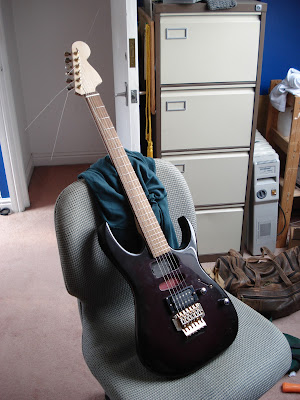
All these things done I gave it a very simple, cursory set up to get the strings somewhere near the fretboard (this involved shimming the neck pocket a little to increase the angle) and plugged it into my amp. I think you could probably have heard my Dr Frankenstein-style laughing from the other side of the street when I figured out that it worked. The frets were even and level, no buzzes or dead notes, the neck felt good in my hands. I gave the truss-rod a tweak and it did what it was supposed to do, correcting the ever-so-slight bow caused by putting it under tension for the first time.
But, of course, I could not call it finished just yet. So after a few more minutes’ playing, I took the strings back off, dismantled it, and prepared for part four: finishing and set up. Do stay tuned for the thrilling conclusion of this saga.
-Ben
I left off at the point where I put the neck back in the box it came in, along with all my tools and the larger offcuts (my experience the previous year taught me that you should never turn up your nose at offcuts of good wood) and took it home. I would have liked to do the rest of the project in the workshop, but sadly I only had a few days off work. I'd done all the things that had to be done in the workshop though, so it wasn't a major problem.
The first task, which had to be completed before I could do anything else, was sorting out the slightly squiffy trussrod rout. This was a time consuming but not particularly difficult process – I sat in my attic watching Doctor Who while gradually widening and straightening the rout with a selection of teensy chisels and files. While doing this I also evened out the shape of the router's little excursion into the heel of the neck. The next day I cut a handful of thin slivers from the veneer-like piece and shoved them into the unwanted rout until they filled it with no visible gaps. I then took them out, slavered them in titebond (which is so much easier to work with than gorilla glue) and jammed them back into the gap with a mallet. When dried and planed flat, you could barely see the repair. At about the same time I took another veneer-piece and glued it to the side of the heel where I'd drifted off the line during the jigsaw phase. Once trimmed and planed to the right shape, it got the neck back to the right shape.
I was pleased with myself, work could now continue.
The next stage was attaching the fretboard, which involved a great deal of persnickety measuring and minute adjustments. It also involved a lot of clamps. Like this.

The neck, held in place with three clamps attached to a big bit of scrap pine. The strange mutant in the background is a scrap of pine that I radiused with a plane and then banged frets into for practice.
Once the neck was firmly glued in place (I kept it clamped securely for two days to be sure) I set about trimming the fretboard to the same size as the neck. It would have been quickest to do this with a saw, but I was terrified of cocking it up so close to completion, so I did it the slow but certain way – with planes and rasps. After I'd done this, I gave the neck back to Kristen so that she could drill the tuning peg holes with the big pillar-drill in her workshop.

The neck after I'd removed all the excess material. It was just balanced on the body for the look of the thing in the picture – I'd not actually bolted it into place yet.
It was through experiments with this mutant neck shown above that I figured out a fretting method that seemed to work pretty well. Like the old method, it was still fundamentally clawhammer based (perhaps one day I'll buy a dead-drop hammer in a fit of wild extravagance). It had, however, a few crucial differences from the old method. First of all, I was using Jescar fretwire, which comes pre-radiused (joy), rather than the flat stuff Stewmac sells. This meant that the curve of the fretwire was consistent and even. Secondly, I found a ratty looking old chopping board in the kitchen made out of a funny sort of rubbery plastic that seemed to have just the right amount of bouncy-vs-hard. This latter point sounds a little odd, but it was possibly the more important of the two developments mentioned so far. By cutting a little square of this and sticking it to the end of my hammer, I was able to knock the frets into place without marking them or exposing them to too much shock and vibration. Finally, I bought a big new pair of end-nippers which Kristen reshaped on her grinding wheel at work, fixing them so that the cutting edge was flush with the face of the nippers. This allowed me to cut the frets pretty much flush with the edge of the fretboard, eliminating the lengthy process of grinding the ends down with a file (a process which often shook frets loose). The whole process of fretting, much to my surprise, went smoothly and only took about an hour and a half.

Frets, behold their shinyness. There's only two strings on there because I was just lining up the neck at this point.
With this done I drilled the holes in the headstock for the tuning peg screws, the string trees and the neck attachment bolts. The last of these was probably the most nerve racking. I did it with a hand drill because I was paranoid about drilling through the front of fingerboard. I'm not entirely satisfied with the fit of the neck in the pocket, but it seems good enough to play. With these things done, I wired up one of the pickups and strung it up.

All these things done I gave it a very simple, cursory set up to get the strings somewhere near the fretboard (this involved shimming the neck pocket a little to increase the angle) and plugged it into my amp. I think you could probably have heard my Dr Frankenstein-style laughing from the other side of the street when I figured out that it worked. The frets were even and level, no buzzes or dead notes, the neck felt good in my hands. I gave the truss-rod a tweak and it did what it was supposed to do, correcting the ever-so-slight bow caused by putting it under tension for the first time.
But, of course, I could not call it finished just yet. So after a few more minutes’ playing, I took the strings back off, dismantled it, and prepared for part four: finishing and set up. Do stay tuned for the thrilling conclusion of this saga.
-Ben
Monday, September 17, 2012
Dumpster Ibanez, Part the Second
A few posts ago I told a tale of a little guitar that couldn't, and of my hamfisted attempts to get it working again. I will now bring things up to date.
Part one ended in the autumn of 2011, with the guitar disassembled and thoroughly buggered. It stayed that way for the next 8 months or so. I cannibalized some of its electronics (including the one nice pickup) for a refurb of my little sister's Yamaha Pacifica, and considered throwing the rest of the instrument away on more than one occasion.
I didn't entirely give up on the project though, and once the post-wedding daze had subsided I started thinking about what to do next. Considering the thorough wrecking I'd given it the previous year, I figured I had to either make a entirely new neck or throw the whole thing in the bin. Last year making a new neck would have been completely beyond the realms of possibility (there's only so much you can do with hand tools and a shitty black+decker workbench in your garden) but now I had a wife who worked in a big carpentry workshop.
This was, I admit, bordering on underpants-gnome logic (Step 1: Wife with workshop, Step 2: ?, Step 3: Guitar Neck!) but it was enough to make me seriously consider how I'd go about building a neck. I bought a few books, read a lot of blog posts, looked into suppliers of wood and parts. I also drew up a set of blueprints for this hypothetical neck using Adobe inDesign. (I know that autocad probably would have been a more appropriate medium, but it took me three years to reach this level of proficiency with inDesign, and so I reserve the right to use it for damn near everything.)

At about this point Kristen learned that most of her colleagues were disappearing over the summer, and that all her students would disappear also. She suggested that if I came in she could teach me how to use all the tools I'd need and help me with the guitar. In return, I'd be someone to talk to. This seemed like a good plan, so I booked a few days off during the summer holidays and bought the parts I'd need.
I still had a rosewood fingerboard left over from the previous fuckup, so all I needed was fretwire, a trussrod, and a slab of a maple. I bought them from Tonetech Luthier Supplies, who are based in the UK, meaning that there was no interminable wait this time around.
The first tool Kristen taught me to use was a handheld Jigsaw. Once I'd shown I could use it without chopping my fingers off or setting fire to the workshop, she let me loose on a big pile of scrap wood. I cut a load of practice necks from pine offcuts and a couple of dummy headstocks from plywood (I couldn't make practice necks from plywood as plywood has no grain and, therefore, can't be carved)
For the first day and a half I did absolutely nothing to the maple blank itself. I simply made batches of practice necks with the jigsaw, and then carved them with my spokeshaves and rasps. I quickly learned that pine is a tricky wood to carve. This isn't because it's tough – it's barely harder to carve than balsa wood – but rather because it's full of knots. I quickly learned that knots are effectively grain randomisers, once your spokeshave gets within about an inch of them, you have no way of knowing which way its going to go. Nonetheless, I made progress, with the necks looking increasingly neck-like as I went on.

In the afternoon of the second day I decided it was time to start work on the neck blank proper. Before I started to do any of this, however, I had to thin the blank down by about 4mm and level it out. A few trial passes with a big jackplane made it quickly apparent that planing away 4mm of rock maple would take me about a week. Canadian Maple is hard.
Kristen took it upstairs and fed it into the bandsaw. It roared into life, I hid in the corner of the room like a startled kitten (I don't like bandsaws). After an ungodly screeching noise, and a small amount of smoke, Kristen pulled the wood away from the blade, having managed to cut a groove about 2mm deep in one side. Canadian Maple is really hard.
The next day, we tried again with a new saw blade. It went gnuurrrrrrrr-whirr-squeeeeeeeee. I hid. Kristen neatly shaved off a veneer-like piece of maple and handing both bits to me. I spent a lot of the rest of the day planing and planing and planing. By the time came to go home I had a big bruise on the palm of both hands, had pulled most of the muscles in my upper body, and had big salty sweat stains on my clothes. Canadian Maple is insanely hard.

On Friday I traced my blueprint onto the now perfectly smooth surface of the neck and fired up the jigsaw. I quickly discovered that Canadian maple is hard work for a little handheld jigsaw. I had to stop on several occasions because it was overheating to the point where my hands hurt. Eventually though, I managed to cut out the neck. This was the point at which I made my first major mistakes. The first happened when I lost track of the pencil line amidst a cloud of sawdust and drifted about 1mm inside the line near the heel. The second was that I forgot that I needed to do the routing first.
I'm not sure whether it was because I'd removed a lot of material already, or if it's just because routers are evil, but this was the point at which the neck sustained another bit of ‘character’. We clamped the neck into an improvised blank made of plywood and Kristen started to carve the channel (I wasn't feeling particularly confident with the router). When she was about three quarters of the way to the heel, moving with even slowness because the wood was putting up a fight, there was a loud ‘plink’ and Kristen immediately stopped the router. It turned out that the blade had overheated and snapped from the sheer effort of cutting through the Canadian Maple of ultimate hardness. When Kristen restarted a few minutes later the replacement bit caught on some imperfection in the wood and, unnoticed by either of us, drifted off course, cutting a channel that curved about 15mm off the centerline. Luckily it chose to do this in the heel of the neck, where the wood is at its thickest and widest. I figured I could fill the gap by gluing pieces of the veneer-like offcut, which would provide the strength and density needed to hold the neck bolts in place. Having declared the neck to be fine, I set to work carving.

Needless to say, carving was really difficult. As with the planing earlier, it was a sweaty, palm-bruising process. I first used my microplane rasp (made in Arkansas by wizards) to rough out the curve of the neck at the headstock join and heel, then carefully shaved away layer after layer of wood with my spokeshave (taking care to go with the grain).

After slicing away enough material that it looked like a neck, I started trying to refine the shape with a regular rasp. I discovered that this was a process akin to cutting through a steel door with a cheesegrater. It made me feel like I was doing something, but I'm not sure it if really achieved much other than to polish it up nicely. Either way, by the end of the day I had something that looked not entirely unlike a guitar neck and felt like I'd been beaten up. Canadian Maple is hard.

How it looked when I downed tools at the end of the day. The weird splodges on the headstock are a mixture of sweat and sawdust. By the end of this few days I was looking thinner and more muscly than I've ever looked in my life. Even if the guitar didn't work, I had at least learned that building guitars is a good workout.
-Ben
I was originally intending for this to be a two part affair. But now I think I'll have to make it three. Tune in some time in the next week for part three: gluing, fretting and finishing.
Part one ended in the autumn of 2011, with the guitar disassembled and thoroughly buggered. It stayed that way for the next 8 months or so. I cannibalized some of its electronics (including the one nice pickup) for a refurb of my little sister's Yamaha Pacifica, and considered throwing the rest of the instrument away on more than one occasion.
I didn't entirely give up on the project though, and once the post-wedding daze had subsided I started thinking about what to do next. Considering the thorough wrecking I'd given it the previous year, I figured I had to either make a entirely new neck or throw the whole thing in the bin. Last year making a new neck would have been completely beyond the realms of possibility (there's only so much you can do with hand tools and a shitty black+decker workbench in your garden) but now I had a wife who worked in a big carpentry workshop.
This was, I admit, bordering on underpants-gnome logic (Step 1: Wife with workshop, Step 2: ?, Step 3: Guitar Neck!) but it was enough to make me seriously consider how I'd go about building a neck. I bought a few books, read a lot of blog posts, looked into suppliers of wood and parts. I also drew up a set of blueprints for this hypothetical neck using Adobe inDesign. (I know that autocad probably would have been a more appropriate medium, but it took me three years to reach this level of proficiency with inDesign, and so I reserve the right to use it for damn near everything.)

The neck blueprint. Clicky to embiggenate.
The pale blue bit is the truss rod rout.
At about this point Kristen learned that most of her colleagues were disappearing over the summer, and that all her students would disappear also. She suggested that if I came in she could teach me how to use all the tools I'd need and help me with the guitar. In return, I'd be someone to talk to. This seemed like a good plan, so I booked a few days off during the summer holidays and bought the parts I'd need.
I still had a rosewood fingerboard left over from the previous fuckup, so all I needed was fretwire, a trussrod, and a slab of a maple. I bought them from Tonetech Luthier Supplies, who are based in the UK, meaning that there was no interminable wait this time around.
The first tool Kristen taught me to use was a handheld Jigsaw. Once I'd shown I could use it without chopping my fingers off or setting fire to the workshop, she let me loose on a big pile of scrap wood. I cut a load of practice necks from pine offcuts and a couple of dummy headstocks from plywood (I couldn't make practice necks from plywood as plywood has no grain and, therefore, can't be carved)
For the first day and a half I did absolutely nothing to the maple blank itself. I simply made batches of practice necks with the jigsaw, and then carved them with my spokeshaves and rasps. I quickly learned that pine is a tricky wood to carve. This isn't because it's tough – it's barely harder to carve than balsa wood – but rather because it's full of knots. I quickly learned that knots are effectively grain randomisers, once your spokeshave gets within about an inch of them, you have no way of knowing which way its going to go. Nonetheless, I made progress, with the necks looking increasingly neck-like as I went on.

The blanks, carved. The top two were the last ones I did before moving on.
In the afternoon of the second day I decided it was time to start work on the neck blank proper. Before I started to do any of this, however, I had to thin the blank down by about 4mm and level it out. A few trial passes with a big jackplane made it quickly apparent that planing away 4mm of rock maple would take me about a week. Canadian Maple is hard.
Kristen took it upstairs and fed it into the bandsaw. It roared into life, I hid in the corner of the room like a startled kitten (I don't like bandsaws). After an ungodly screeching noise, and a small amount of smoke, Kristen pulled the wood away from the blade, having managed to cut a groove about 2mm deep in one side. Canadian Maple is really hard.
The next day, we tried again with a new saw blade. It went gnuurrrrrrrr-whirr-squeeeeeeeee. I hid. Kristen neatly shaved off a veneer-like piece of maple and handing both bits to me. I spent a lot of the rest of the day planing and planing and planing. By the time came to go home I had a big bruise on the palm of both hands, had pulled most of the muscles in my upper body, and had big salty sweat stains on my clothes. Canadian Maple is insanely hard.

On Friday I traced my blueprint onto the now perfectly smooth surface of the neck and fired up the jigsaw. I quickly discovered that Canadian maple is hard work for a little handheld jigsaw. I had to stop on several occasions because it was overheating to the point where my hands hurt. Eventually though, I managed to cut out the neck. This was the point at which I made my first major mistakes. The first happened when I lost track of the pencil line amidst a cloud of sawdust and drifted about 1mm inside the line near the heel. The second was that I forgot that I needed to do the routing first.
I'm not sure whether it was because I'd removed a lot of material already, or if it's just because routers are evil, but this was the point at which the neck sustained another bit of ‘character’. We clamped the neck into an improvised blank made of plywood and Kristen started to carve the channel (I wasn't feeling particularly confident with the router). When she was about three quarters of the way to the heel, moving with even slowness because the wood was putting up a fight, there was a loud ‘plink’ and Kristen immediately stopped the router. It turned out that the blade had overheated and snapped from the sheer effort of cutting through the Canadian Maple of ultimate hardness. When Kristen restarted a few minutes later the replacement bit caught on some imperfection in the wood and, unnoticed by either of us, drifted off course, cutting a channel that curved about 15mm off the centerline. Luckily it chose to do this in the heel of the neck, where the wood is at its thickest and widest. I figured I could fill the gap by gluing pieces of the veneer-like offcut, which would provide the strength and density needed to hold the neck bolts in place. Having declared the neck to be fine, I set to work carving.

Carving in progress. This was about an hour's work, believe it or not. If you look very carefully, you can just about see the router’s little detour at the heel of the neck next to the clamp.
Needless to say, carving was really difficult. As with the planing earlier, it was a sweaty, palm-bruising process. I first used my microplane rasp (made in Arkansas by wizards) to rough out the curve of the neck at the headstock join and heel, then carefully shaved away layer after layer of wood with my spokeshave (taking care to go with the grain).

Looking up from the heel to the headstock. At this point I thought I was about halfway done with the carving. Hah.
After slicing away enough material that it looked like a neck, I started trying to refine the shape with a regular rasp. I discovered that this was a process akin to cutting through a steel door with a cheesegrater. It made me feel like I was doing something, but I'm not sure it if really achieved much other than to polish it up nicely. Either way, by the end of the day I had something that looked not entirely unlike a guitar neck and felt like I'd been beaten up. Canadian Maple is hard.

How it looked when I downed tools at the end of the day. The weird splodges on the headstock are a mixture of sweat and sawdust. By the end of this few days I was looking thinner and more muscly than I've ever looked in my life. Even if the guitar didn't work, I had at least learned that building guitars is a good workout.
-Ben
I was originally intending for this to be a two part affair. But now I think I'll have to make it three. Tune in some time in the next week for part three: gluing, fretting and finishing.
Thursday, August 30, 2012
Bus Repellent
I, like most people, think of myself as a rational, sensible person. I don't believe in fairies, gods, or ghosts and I consider it extremely unlikely (like ‘struck by lighting on the toilet’ unlikely) that we'll ever be visited by aliens. Nonetheless, like all people who think of themselves as sensible and rational, I find odd little superstitions and irrational beliefs creeping into my thinking from time to time. I don't resent these things, or consider them to be failings (they're a normal part of being human, after all), but it is a little alarming the way that they insidiously work their way into your thinking.
A good example of this is my relationship with buses. I don't own a car, and I can't drive, so I tend to spend a lot of time on public transport. The ineffable chaos theory that governs urban traffic makes a mockery of any attempt to impose a train-style timetable on bus services. The frequency and timing of buses is, for all intents and purposes, random. I remember reading a few years ago about an experiment where animals were placed in cages with a machine that dispensed food pellets at random intervals. In almost every case, within a few days the animals had become convinced that some action of theirs was making food pellets come out; they'd do strange dances and movements that they thought made the pellets appear, and didn't seem to notice that they appeared even when they were still.
Like the animals in the cages, when presented with something that was essentially random (in my case, buses), I started to develop an odd and superstitious way of thinking. At first, these superstitions were just a sort of in-joke between me and Kristen, something to talk about while waiting for a bus to appear. But as time went on I increasingly found myself seriously considering these ideas. When waiting for buses, for example, we'd sometimes dramatically turn and walk away from the bus stop, muttering about how we were going to walk home, in the hope of ‘summoning’ a bus. This was just a bit of harmless silliness until the day I found myself doing this when I was on my own. On an empty street. At about 1am.
I felt a bit stupid after that.
The most insidious of these weird superstitions, however, was the belief that Kristen was afflicted with some sort of curse that drove buses away. Again – this started as a joke – me talking about how she shouldn't have desecrated the high altar of the secretive Bus Cult, or something like that, while we were waiting for a bus in the rain. Like the others though, this soon crossed the line from the shelves in my mind marked ‘silly fictions’ to the shelves marked ‘real things’, with me subconsciously looking for proof of its existence.
The world was happy to oblige my weird superstitions at this point: Kristen seemed to be singularly unlucky with buses, and when I was with her, so was I. It wasn't just buses either. I remember there was one particular week when she had a gig up in London and got the train in with me a few times, each time there was some kind of catastrophic railway implosion; delays, cancellations, and long periods of sitting in stationary trains. The rest of the time I got into work just fine.
There was one day when I realized that I was seriously taking Kristen's ‘Bus Repellent’ – as I'd come to think of it – into account while planning our route to the pub. Allowing a more than generous amount of time to get there and trying to come up with a route that minimized the possibility of interference from the bus gods. This entirely imagined problem actually made me resent Kristen for a while – I started getting a later train into work (although admittedly this was mostly motivated by laziness) to ensure that I was not troubled by her influence.
I'm not sure what caused this odd superstition to eventually ebb away. I'd like to think that it was me being sensible and rational, but I don't think it was. I think it was just basic probabilities – Kristen's luck got better, mine got worse; things felt like they were leveling out. Our lives got a lot less stressful as well, which certainly helped me care less about minor inconveniences.
I think this superstition was dealt a final death-blow a few months ago when TFL unveiled their live bus updates system. It's taken the random and mysterious element out of public transport, like scientists figuring out lightning did for the thunder gods...
----
As a little postscript for this strange ramble (which I started intending for it to be about something else entirely, something that I'll have to write about another day) I'd like to briefly outline my attitude to the universe as pertains to things other than buses. Like I mentioned further up, I'm not a believer in gods, nor do I wistfully believe that ‘there has to be something out there’. I do, however, believe firmly in the fundamental malevolence of all things. I have found that if there's two ways something can happen, and both are as likely as the other, then the shittier option will be the one that takes place.
A case in point – and the incident that led me to formulate this philosophy in the first place – a few years ago, when I was working on a guitar, I found myself faced with a dilemma. The pickup I was trying to install was an old and strange one (a late-1980s DiMarzio Jazz, as I recall) with no obvious logic to the color coding of its output wires. It was a humbucker, so, four wires coming out. I was able to identify two of them, but the other two were a mystery.
I realized that I had a 50/50 choice. If I wired them one way, the pickup would work fine. If I wired them up the other way, the pickup would be out of phase. I would have no way of knowing whether I'd gotten it right or not until after I'd completed the wiring, reattached the bridge, and restrung the instrument. I had a nasty suspicion that whichever way I chose to do it, it would turn out to be the wrong way and I was right. The damn thing was out of phase and I had to spent about an hour taking off the strings and rewiring it.
A few months later I found myself faced with the exact same problem in a different guitar. Once again, I made my choice and once again I was wrong. I've come up against many variations on this basic conundrum over the years (usually as a result of me dropping some extremely complicated switch I'd just finished pre-wiring and forgetting which end was which) and only once have I ever gotten it right.
Saturday, August 18, 2012
Dumpster Ibanez, Part the First
About two years ago, while walking back from the shops near my house, I
saw a guitar headstock sticking out of a bin. Curious, I walked over and
had a look. I saw a slightly battered looking 90s Ibanez, with an
RG-shape body, very worn and battered looking hardware, and a snapped
neck. I didn't recognize the model name on the headstock, but it was
clearly a fairly low-end guitar. If it wasn't for the fact that I could
see ‘Seymour Duncan’ written on the bridge pickup (SD are a maker of
nice aftermarket pickups that cost about £70 each) I would have left it
where it was. The neck didn't look that badly broken and I figured that,
if nothing else, the electronics were worth salvaging, so I pulled it
out of the bin and took it home, much to Kristen's annoyance.


When I got back to the house I cleaned it up a bit and gave it a closer examination. The break was worse than it had initially appeared; the neck and fingerboard were sheared through and the strings were the only thing holding the headstock in place. Some material had split off and been lost from the back of the neck, exposing the truss rod. The rest of the guitar was in a similarly poor state. The neck pickup was covered with a layer of gaffa tape that disguised a gaping hole in the front. The hair-thin wire of the coils had clearly been damaged, rendering the pickup useless. When I tried to dismantle the Floyd Rose tremolo I found that several of the machine screws holding the saddles in place had been cross-threaded. It took some vice-grips and a great deal of effort to get them out, and, once removed, they would not go back in.
For a guitar that probably cost no more than £200 to begin with, it was clearly too badly damaged to be worth the effort of repairing. Nonetheless, I decided to try. I'd been doing minor repairs to guitars for years and was excited by the opportunity to try my hand at the woodworking and fretting side of things.
Things didn't start well. In fact, they started pretty terribly. I'm not sure if this was entirely down to my incompetence (it was a cheap instrument, designed without much consideration for how it could be repaired), but I'm pretty sure my incompetence was the main contributing factor.
I decided that the first thing I needed to do was remove the fretboard so that I could remove the truss rod. I used lots of water and a heated palette-knife to try and ease apart the glue-join, but it would not cooperate. I had to use increasing amounts of force which eventually resulted in the fretboard disintegrating. This was probably unavoidable – to save costs, the fretboards on these instruments are very thin, with barely 1mm of clearance between the bottom of the fretwire and the underside of the board – but in retrospect I'm not sure if I actually *had* to take the fretboard off. It may have been possible to reattach the neck without doing any of that.
So, after round one I had a shredded fretboard which I would have to replace and re-fret. I wanted to teach myself how to do fretting anyway, however, so I wasn't overly bothered. Moreover, not only do I rarely every play electric guitars, I also already have one. So I wasn't in any rush. I bought two pre-cut fretboards from Stewart MacDonald (one just in case I fucked up the first one) and a few metres of fretwire.
While waiting for the fretboards to arrive, I decided to get on with the business of attaching the headstock. My plan was sound – reglue the bits I had, then square off the ragged hole in the back of the neck and plug it – but my execution was lacking. Having never really done any woodworking before, and not having any of the proper tools, I struggled to make the hole square. Each attempt to make the gap a more regular shape just made the hole bigger, until I had carved out a section that was so deep it critically weakened the neck join. After a great deal of practice with scrap wood I was able to carve out a half-decent plug for this hole, but it was never going to hold.


The plug. I got a lot of practice carving wood before I scrounged a chunk of scrap maple from a guitar workshop on Denmark street. That large vertical glue join would undoubtedly fail the second strings were put on. Seeing as I buggered up the Fretwork, however, this never actually happened.
I decided to plow on anyway, however, because I figured I may as well get practice making the whole neck, even if it was never going to be usable. I glued the fretboard on (with gorilla glue – a bad choice) and had a go at fretting. Again, this wasn't something I'd ever attempted before, and I didn't have any of the right tools. I had no consistent way of bending the fretwire before I pushed it in, so the ends tended to spring out of their slots the second I turned my back. Also, as the fretwire wasn't curved to a consistent radius, it tended to be all lumpy and odd even when it was seated properly.
It didn't help, of course, that I was essentially just trying to mash the stuff into place with a clawhammer. Each fret was traumatisingly battered by the time I've managed to get it seated halfway right.
I declared the neck to be soundly and completely fucked up, and gave up.

The poor thing when it first arrived

It had suffered an accident, possibly guitar flip related.

Top half is sheared along the neck join, bottom half is ragged.
When I got back to the house I cleaned it up a bit and gave it a closer examination. The break was worse than it had initially appeared; the neck and fingerboard were sheared through and the strings were the only thing holding the headstock in place. Some material had split off and been lost from the back of the neck, exposing the truss rod. The rest of the guitar was in a similarly poor state. The neck pickup was covered with a layer of gaffa tape that disguised a gaping hole in the front. The hair-thin wire of the coils had clearly been damaged, rendering the pickup useless. When I tried to dismantle the Floyd Rose tremolo I found that several of the machine screws holding the saddles in place had been cross-threaded. It took some vice-grips and a great deal of effort to get them out, and, once removed, they would not go back in.
For a guitar that probably cost no more than £200 to begin with, it was clearly too badly damaged to be worth the effort of repairing. Nonetheless, I decided to try. I'd been doing minor repairs to guitars for years and was excited by the opportunity to try my hand at the woodworking and fretting side of things.
Things didn't start well. In fact, they started pretty terribly. I'm not sure if this was entirely down to my incompetence (it was a cheap instrument, designed without much consideration for how it could be repaired), but I'm pretty sure my incompetence was the main contributing factor.
I decided that the first thing I needed to do was remove the fretboard so that I could remove the truss rod. I used lots of water and a heated palette-knife to try and ease apart the glue-join, but it would not cooperate. I had to use increasing amounts of force which eventually resulted in the fretboard disintegrating. This was probably unavoidable – to save costs, the fretboards on these instruments are very thin, with barely 1mm of clearance between the bottom of the fretwire and the underside of the board – but in retrospect I'm not sure if I actually *had* to take the fretboard off. It may have been possible to reattach the neck without doing any of that.
So, after round one I had a shredded fretboard which I would have to replace and re-fret. I wanted to teach myself how to do fretting anyway, however, so I wasn't overly bothered. Moreover, not only do I rarely every play electric guitars, I also already have one. So I wasn't in any rush. I bought two pre-cut fretboards from Stewart MacDonald (one just in case I fucked up the first one) and a few metres of fretwire.
While waiting for the fretboards to arrive, I decided to get on with the business of attaching the headstock. My plan was sound – reglue the bits I had, then square off the ragged hole in the back of the neck and plug it – but my execution was lacking. Having never really done any woodworking before, and not having any of the proper tools, I struggled to make the hole square. Each attempt to make the gap a more regular shape just made the hole bigger, until I had carved out a section that was so deep it critically weakened the neck join. After a great deal of practice with scrap wood I was able to carve out a half-decent plug for this hole, but it was never going to hold.

Gluing the neck back together.

I decided to plow on anyway, however, because I figured I may as well get practice making the whole neck, even if it was never going to be usable. I glued the fretboard on (with gorilla glue – a bad choice) and had a go at fretting. Again, this wasn't something I'd ever attempted before, and I didn't have any of the right tools. I had no consistent way of bending the fretwire before I pushed it in, so the ends tended to spring out of their slots the second I turned my back. Also, as the fretwire wasn't curved to a consistent radius, it tended to be all lumpy and odd even when it was seated properly.
It didn't help, of course, that I was essentially just trying to mash the stuff into place with a clawhammer. Each fret was traumatisingly battered by the time I've managed to get it seated halfway right.
I declared the neck to be soundly and completely fucked up, and gave up.
Subscribe to:
Posts (Atom)